

September, 2009
The Climax of the story is actually the CURE, the breakthrough, the revelation of a process
|
Quote of the month: "Your audience learns the most from HOW you overcame the obstacle. It's not simply the 0vercoming of the obstacle that is important, it is the method that you use." –Doug Stevenson, speaker, author www.storytheater.net 
|
Opening: Do you recall a time when you were reading a book, watching a movie or hearing someone tell you a great story where the conflict was building and building and you just couldn't wait to hear or watch the climax, the high point? In the speaking world, all too often a speaker tends to omit this crucial scene and jump right into the conclusion.
Promise: If you skip the climatic scene your audience will feel dissatisfied as they would be cheated of something that they have anxiously been awaiting. On the other hand, if you describe this important, anxiously awaited scene, you will satisfy their curiosity, keep them at the edge of their seats and at the same time, teach them a life lesson.
Roadmap: There are 9 C's in Craig Valentine's "Storytelling Home-Study Course for Speakers," starting with the embedding of Curiosity throughout the 8 stages of storytelling; from the setting up of the Circumstance to the ending of Carry-out Message. The one C we will examine is the Climax, or the high point of the story. We will look at 3 aspects of the Climax.
|  |
|
What the climactic scene is |
|
|
|
Why it is so important a scene |
|
|
|
What it shouldn't and should include |
What is the climactic scene?
|
|
The highest point that shows a revelation/ a realization which occurs in a character's mind |
|
|
The breakthrough scene the audience has been anxiously awaiting to hear |
|
|
The "cure" that the audience needs to hear to help them get "cured" too of possibly a similar problem, obstacle |
Why is it so important?
|
|
Shows what created the turning point and how it was done |
|
|
Releases built up tension you developed in your story |
|
|
Imperative that audience find out specifically what you learned, understand clearly how you learned it and if that learned process will work for them as well |
What should it not include?
|
|
Avoid being the guru, appearing superior, egotistical or special; By placing yourself on a pedestal, audiences will not relate to you, possibly not trust you, and likely never follow your
advice
|
What should it include?
|
|
A significant emotional event in which a revelation/a realization, occurs in the mind of a character |
|
|
A passing of wisdom, a lesson, a process, a solution, a new way of thinking, feeling, acting |
|
|
How you came upon the knowledge of this cure or wisdom- a guru: someone or something that gives the speaker the cure. *** most effective way to do this, is to find characters to whom the audience can relate, maybe one of similar age to them. If they can relate to him/her, that will connect them to you |
|
|
Making yourself humble and similar to them by asking rhetorical questions, such as: "Have you ever felt such vulnerability? I have." or "Just like me, do you recall a time when...?" |
|
|
Giving the PROCESS you learned the power |
Craig Valentine states:
| 1. | |
"Whatever you do... ALWAYS remember the following words: Give the PROCESS, not the PERSON, the POWER! Give the PROCESS, not the PERSON, the POWER! Give the PROCESS, not the PERSON, the POWER!" |
| 2. | |
"Making yourself a similar person who has a special process to share will make you more attractive to potential clients, more effective in the long-term and more valuable than 99% of the self-glorifying speakers out there." |
| 3. | |
"When your audience knows that the process made the difference, they will do whatever it takes to get that process." |
A suggested challenge for you now is to think about and record significant ideas, lessons, universal truths you have learned in your life that have affected you in a positive significant way. When you identify them and record them, boast about them in a manner that highlights the Process, not you the person.
P.S. This was an explanation of only 1 of the 9 C's that I have studied and learned from Craig Valentine's most popular speaking resource: "The Edge of Their Seats Storytelling Home-Study Course for Speakers." If you're interested in discovering the components of all 9 C's to enhance your own storytelling techniques and captivate your audiences, you may wish to click the graphic below and read for yourself the benefits you'll receive by investing in this resource.
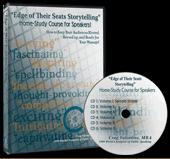
P.S.S. I am thrilled to inform you that this month, I have decided to continue to raise the bar of my coaching skills to a world class level. So I have invested in Mitch Meyerson's and Craig Valentine's WORLD CLASS COACHING CLASS. Receiving my World Class Coaching Accreditation will benefit greatly the business people I coach in their presentation skills.
If you are interested in finding out more about becoming a Certified World Class Speaking Coach, which starts on September 21st, click here. At last check, there were 2 openings still available.
I invite you to join me next month when we look at the letter "D" as it relates to another speaking skill. Until then,
Happy Speaking!

Kathryn@kathrynmackenzie.com
416.489.6603
If you wish to unsubscribe from these newsletters, please click here. On the other hand, if you know someone who may benefit from these newsletters, please forward them. Thank you.
www.kathrynmackenzie.com
© 2009 All rights reserved