

April, 2009
X Marks the Spot!
Use Different Spots on the Platform to make your Points!
|
Quote of the month: "People may not remember what you said, but they're more likely to remember what they saw ... when and where you said it." –Unknown |
 When you're speaking, do you remain glued down to one spot, or do you pace aimlessly across the platform?
To involve your audience in what you are saying, it takes more than hearing your words. To experience your stories or message, they must be involved using all their senses!
Consequently, when you do move on the platform, you need to move with a purpose.
Phrasing helps with Staging!
| Tips on Moving on the Platform with a Purpose | ||
| Why Choreograph | When to do so | How to do so |
| To tap into audience's emotions by stressing an important point and move them to action | When you want to connect emotionally with them, have them reflect and realize a process | Move to the power position when giving your power statement. STOP upfront and centre (pause, lower your voice, slow down in your delivery) |
| To create a lasting picture so the audience will use all their senses (yes even smell and touch, i.e., chocolate chip cookies baking or the feel of soft leather couch) | When you create a scene | Create different scenes with characters, dialogue, and actions in the listeners' minds which they can easily visualize – it helps them remember and differentiate from one event/story/point to another. At the end of your speech, when you refer to something you have already said, just call it back by gesturing to the spots where you spoke about it. Doing this will evoke emotion in your audience because they will be able to "see" in their minds the story you had talked about in that spot. |
| To establish congruency between words and actions | When you use traveling or actions words | Demonstrate traveling/action words as they give you a valid reason to move "I walked to my car and ..." "I saw the chair across the room and collapsed..." "I boldly took a few steps forward..." |
| To differentiate between points | When you want to change points/ideas | Designate a spot on the stage for each point/idea within your speech and demonstrate visual transitions from one point/story to the next i.e. "On the other hand..." "Having said that, there is another point..." "Similarly, this other story..." In these cases, where you move is irrelevant; just visually show a transition |
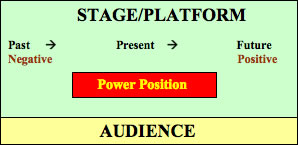
| To create timelines | When you are sequencing events | Split the platform to show different spots for the past, the present and the future "If you could have seen me four months ago, you would have seen ..." PAST "Right at this moment, I..." "Now forward 3 years..." "And over the next 2 decades, I changed from being ..." PAST to PRESENT "In the future, I would like to move towards..." Gesture or move to the FUTURE location |
| To differentiate between opposites | When you want to differentiate between: bad from good negative from positive OR problem and a solution |
Use audience's left side for the bad, the negative, the problem, and the right side for the opposite effect, reaction or result i.e. "If you don't_______, then you will_______" Bad/negative location "But if you do take heed and ________, you will experience________" Good/positive location |
I challenge you to move with purpose on the platform. Do not remain glued to one spot.
Do not wander aimlessly as your movements will be meaningless and distracting to the audience.
When you move, move purposefully. How you use the platform is up to you, but use it intentionally!
I invite you to join me next month when we examine the letter "Y". You will read about a slight edge, yet profound, strategy by discovering the most important word in speaking, when to use it and how to use it.
P.S. Toastmaster International District Spring Conferences 2009
District 60 Valhalla Inn, Toronto April 17-19. Registration: www.toastmasters60.org
Darren LaCroix 2001 W.C.P.S. is the keynote speaker & main workshop presenter
District 86 Holiday Inn, Burlington April 24-27. Registration: www.toastmasters86.org
Craig Valentine 1999 W.C.P.S. is the keynote speaker & main workshop presenter
 REMINDER: Champ Camp with Darren and Craig is taking place at the Valhalla Inn in Toronto on the weekend of May 30-31, 2009. |

Kathryn@kathrynmackenzie.com
416.489.6603
If you wish to unsubscribe from these newsletters, please click here. On the other hand, if you know someone who may benefit from these newsletters, please forward them. Thank you.
www.kathrynmackenzie.com
© 2009 All rights reserved